Appendice C Conseils et réponses aux exercices choisis
1 Préliminaires
1.4 Exercices
1.4.2.
1.4.6.
1.4.10.
1.4.14.
1.4.17.
1.4.18.
1.4.20.
1.4.22.
Indication.
(a) Soient \(x, y \in A\text{.}\) Alors \(g(f(x)) = (g \circ f)(x) = (g \circ f)(y) = g(f(y))\text{.}\) Donc \(f(x) = f(y)\) et \(x = y\text{,}\) de sorte que \(g \circ f\) est injective. (b) Soit \(c \in C\text{,}\) alors \(c = (g \circ f)(x) = g(f(x))\) pour un certain \(x \in A\text{.}\) Comme \(f(x) \in B\text{,}\) \(g\) est surjective.
1.4.23.
1.4.24.
Indication.
(a) Soit \(y \in f(A_1 \cup A_2)\text{.}\) Il existe alors un \(x \in A_1 \cup A_2\) tel que \(f(x) = y\text{.}\) Donc \(y \in f(A_1)\) ou \(y \in f(A_2)\text{.}\) Par conséquent, \(y \in f(A_1) \cup f(A_2)\text{.}\) Ainsi, \(f(A_1 \cup A_2) \subset f(A_1) \cup f(A_2)\text{.}\) Réciproquement, si \(y \in f(A_1) \cup f(A_2)\text{,}\) alors \(y \in f(A_1)\) ou \(y \in f(A_2)\text{.}\) Il existe donc un \(x\) dans \(A_1\) ou \(A_2\) tel que \(f(x) = y\text{.}\) Ainsi, il existe un \(x \in A_1 \cup A_2\) tel que \(f(x) = y\text{.}\) Par conséquent, \(f(A_1) \cup f(A_2) \subset f(A_1 \cup A_2)\text{,}\) et \(f(A_1 \cup A_2) = f(A_1) \cup f(A_2)\text{.}\)
1.4.25.
1.4.28.
2 Les entiers
2.4 Exercices
2.4.1.
Indication.
Le cas de base, \(S(1): [1(1 + 1)(2(1) + 1)]/6 = 1 = 1^2\) est vrai. Supposons que \(S(k): 1^2 + 2^2 + \cdots + k^2 = [k(k + 1)(2k + 1)]/6\) est vraie. Alors
\begin{align*}
1^2 + 2^2 + \cdots + k^2 + (k + 1)^2 & = [k(k + 1)(2k + 1)]/6 + (k + 1)^2\\
& = [(k + 1)((k + 1) + 1)(2(k + 1) + 1)]/6\text{,}
\end{align*}
donc \(S(k + 1)\) est vraie. Ainsi, \(S(n)\) est vraie pour tout entier positif \(n\text{.}\)
2.4.3.
2.4.8.
Indication.
Suivez la démonstration de l’Exemple 2.1.4.
2.4.11.
Indication.
Le cas de base, \(S(0): (1 + x)^0 - 1 = 0 \geq 0 = 0 \cdot x\) est vrai. Supposons que \(S(k): (1 + x)^k -1 \geq kx\) est vraie. Alors
\begin{align*}
(1 + x)^{k + 1} - 1 & = (1 + x)(1 + x)^k -1\\
& = (1 + x)^k + x(1 + x)^k - 1\\
& \geq kx + x(1 + x)^k\\
& \geq kx + x\\
& = (k + 1)x\text{,}
\end{align*}
donc \(S(k + 1)\) est vraie. Donc \(S(n)\) est vraie pour tout entier positif \(n\text{.}\)
2.4.17. Nombres de Fibonacci.
Indication.
Pour (a) et (b), utilisez le raisonnement par récurrence. (c) Montrez que \(f_1 = 1\text{,}\) \(f_2 = 1\text{,}\) et \(f_{n + 2} = f_{n + 1} + f_n\text{.}\) (e) Utilisez la partie (b) et l’Exercice 2.4.16.
2.4.19.
2.4.23.
2.4.27.
2.4.29.
3 Groupes
3.5 Exercices
3.5.1.
3.5.2.
3.5.6.
3.5.8.
3.5.15.
3.5.16.
3.5.17.
3.5.18.
Indication.
Soit
\begin{equation*}
\sigma =
\begin{pmatrix}
1 & 2 & \cdots & n \\ a_1 & a_2 & \cdots & a_n
\end{pmatrix}
\end{equation*}
un élément de \(S_n\text{.}\) Tous les \(a_i\) doivent être distincts. Il y a \(n\) façons de choisir \(a_1\text{,}\) \(n - 1\) façons de choisir \(a_2, \ldots\text{,}\) 2 façons de choisir \(a_{n - 1}\text{,}\) et une seule façon de choisir \(a_n\text{.}\) Donc nous pouvons former \(\sigma\) de \(n(n - 1) \cdots 2 \cdot 1 = n!\) façons.
3.5.25.
3.5.31.
3.5.35.
3.5.41.
3.5.46.
3.5.49.
4 Groupes cycliques
4.5 Exercices
4.5.1.
4.5.2.
4.5.3.
Indication.
(a) \(7 {\mathbb Z} = \{ \ldots, -7, 0, 7, 14, \ldots \}\) ; (b) \(\{ 0, 3, 6, 9, 12, 15, 18, 21 \}\) ; (c) \(\{ 0 \}\text{,}\) \(\{ 0, 6 \}\text{,}\) \(\{ 0, 4, 8 \}\text{,}\) \(\{ 0, 3, 6, 9 \}\text{,}\) \(\{ 0, 2, 4, 6, 8, 10 \}\) ; (g) \(\{ 1, 3, 7, 9 \}\) ; (j) \(\{ 1, -1, i, -i \}\text{.}\)
4.5.4.
Indication.
(a)
\begin{equation*}
\begin{pmatrix}
1 & 0 \\
0 & 1
\end{pmatrix},
\begin{pmatrix}
-1 & 0 \\
0 & -1
\end{pmatrix},
\begin{pmatrix}
0 & -1 \\
1 & 0
\end{pmatrix},
\begin{pmatrix}
0 & 1 \\
-1 & 0
\end{pmatrix}\text{.}
\end{equation*}
(c)
\begin{equation*}
\begin{pmatrix}
1 & 0 \\
0 & 1
\end{pmatrix},
\begin{pmatrix}
1 & -1 \\
1 & 0
\end{pmatrix},
\begin{pmatrix}
-1 & 1 \\
-1 & 0
\end{pmatrix}, \\
\begin{pmatrix}
0 & 1 \\
-1 & 1
\end{pmatrix},
\begin{pmatrix}
0 & -1 \\
1 & -1
\end{pmatrix},
\begin{pmatrix}
-1 & 0 \\
0 & -1
\end{pmatrix}\text{.}
\end{equation*}
4.5.10.
4.5.11.
4.5.15.
4.5.16.
4.5.17.
4.5.18.
4.5.22.
4.5.27.
4.5.31.
4.5.37.
5 Groupes de permutations
5.4 Exercices
5.4.1.
5.4.2.
5.4.3.
5.4.4.
5.4.5.
5.4.8.
5.4.11.
5.4.17.
5.4.25.
5.4.29.
5.4.30.
6 Classes latérales et théorème de Lagrange
6.5 Exercices
6.5.1.
6.5.2.
6.5.3.
6.5.4.
6.5.5.
Indication.
(a) \(\langle 8 \rangle\text{,}\) \(1 + \langle 8 \rangle\text{,}\) \(2 + \langle 8 \rangle\text{,}\) \(3 + \langle 8 \rangle\text{,}\) \(4 + \langle 8 \rangle\text{,}\) \(5 + \langle 8 \rangle\text{,}\) \(6 + \langle 8 \rangle\text{,}\) et \(7 + \langle 8 \rangle\) ; (c) \(3 {\mathbb Z}\text{,}\) \(1 + 3 {\mathbb Z}\) et \(2 + 3 {\mathbb Z}\text{.}\)
6.5.7.
6.5.12.
6.5.19.
6.5.22.
Indication.
7 Introduction à la cryptographie
7.4 Exercices
7.4.1.
7.4.3.
7.4.4.
7.4.7.
7.4.9.
7.4.10.
8 Théorie algébrique des codes
8.6 Exercices
8.6.2.
8.6.3.
8.6.4.
8.6.6.
8.6.7.
Indication.
-
\((00000), (00101), (10011), (10110)\)\begin{equation*} G = \begin{pmatrix} 0 & 1 \\ 0 & 0 \\ 1 & 0 \\ 0 & 1 \\ 1 & 1 \end{pmatrix} \end{equation*}
-
\((000000), (010111), (101101), (111010)\)\begin{equation*} G = \begin{pmatrix} 1 & 0 \\ 0 & 1 \\ 1 & 0 \\ 1 & 1 \\ 0 & 1 \\ 1 & 1 \end{pmatrix} \end{equation*}
8.6.9.
8.6.11.
Indication.
(a) Une matrice de contrôle de parité canonique avec la matrice génératrice standard
\begin{equation*}
G =
\begin{pmatrix}
1 \\ 1 \\ 0 \\ 0 \\ 1
\end{pmatrix}\text{.}
\end{equation*}
(c) Une matrice de contrôle de parité canonique avec la matrice génératrice standard
\begin{equation*}
G =
\begin{pmatrix}
1 & 0 \\
0 & 1 \\
1 & 1 \\
1 & 0
\end{pmatrix}\text{.}
\end{equation*}
8.6.12.
8.6.15.
Indication.
8.6.19.
8.6.23.
9 Isomorphismes
9.4 Exercices
9.4.1.
Indication.
9.4.2.
9.4.3.
9.4.6.
9.4.8.
9.4.11.
9.4.16.
9.4.19.
9.4.20.
9.4.25.
9.4.27.
9.4.38.
9.4.45.
10 Sous-groupes normaux et groupes quotients
10.4 Exercices
10.4.1.
10.4.8.
10.4.11.
10.4.12.
10.4.14.
Indication.
(a) Soit \(g \in G\) et \(h \in G'\text{.}\) Si \(h = aba^{-1}b^{-1}\text{,}\) alors
\begin{align*}
ghg^{-1} & = gaba^{-1}b^{-1}g^{-1}\\
& = (gag^{-1})(gbg^{-1})(ga^{-1}g^{-1})(gb^{-1}g^{-1})\\
& = (gag^{-1})(gbg^{-1})(gag^{-1})^{-1}(gbg^{-1})^{-1}\text{.}
\end{align*}
Nous devons également montrer que si \(h = h_1 \cdots h_n\) avec \(h_i = a_i b_i a_i^{-1} b_i^{-1}\text{,}\) alors \(ghg^{-1}\) est un produit d’éléments du même type. Or, \(ghg^{-1} = g h_1 \cdots h_n g^{-1} = (gh_1g^{-1})(gh_2g^{-1}) \cdots (gh_ng^{-1})\text{.}\)
11 Homomorphismes
11.4 Exercices
11.4.2.
11.4.4.
11.4.5.
Indication.
Pour tout homomorphisme \(\phi : {\mathbb Z}_{24} \rightarrow {\mathbb Z}_{18}\text{,}\) le noyau de \(\phi\) doit être un sous-groupe de \({\mathbb Z}_{24}\) et l’image de \(\phi\) doit être un sous-groupe de \({\mathbb Z}_{18}\text{.}\) Utilisez ensuite le fait qu’un générateur doit être envoyé sur un générateur.
11.4.9.
11.4.17.
12 Groupes de matrices et symétrie
12.4 Exercices
12.4.1.
Indication.
\begin{align*}
\frac{1}{2} \left[ \|{\mathbf x} + {\mathbf y}\|^2 + \|{\mathbf x}\|^2 - \| {\mathbf y}\|^2 \right] & = \frac{1}{2} \left[ \langle x + y, x + y \rangle - \|{\mathbf x}\|^2 - \| {\mathbf y}\|^2 \right]\\
& = \frac{1}{2} \left[ \| {\mathbf x}\|^2 + 2 \langle x, y \rangle + \| {\mathbf y}\|^2 - \|{\mathbf x}\|^2 - \| {\mathbf y}\|^2 \right]\\
& = \langle {\mathbf x}, {\mathbf y} \rangle\text{.}
\end{align*}
12.4.3.
12.4.5.
12.4.7.
12.4.10.
12.4.13.
12.4.17.
13 La structure des groupes
13.4 Exercices
13.4.1.
13.4.4.
Indication.
13.4.7.
13.4.12.
13.4.16.
13.4.21.
14 Actions de groupes
14.5 Exercices
14.5.1.
Indication.
Exemple 14.1.1 : \(0\text{,}\) \({\mathbb R}^2 \setminus \{ 0 \}\text{.}\) Exemple 14.1.2 : \(X = \{ 1, 2, 3, 4 \}\text{.}\)
14.5.2.
Indication.
(a) \(X_{(1)} = \{1, 2, 3 \}\text{,}\) \(X_{(1 \, 2)} = \{3 \}\text{,}\) \(X_{(1 \, 3)} = \{ 2 \}\text{,}\) \(X_{(2 \, 3)} = \{1 \}\text{,}\) \(X_{(1 \, 2 \, 3)} = X_{(1 \, 3 \, 2)} = \emptyset\text{.}\) \(G_1 = \{ (1), (2 \, 3) \}\text{,}\) \(G_2 = \{(1), (1 \, 3) \}\text{,}\) \(G_3 = \{ (1), (1 \, 2)\}\text{.}\)
14.5.3.
14.5.6.
Indication.
Les classes de conjugaison de \(S_4\) sont
\begin{gather*}
{\mathcal O}_{(1)} = \{ (1) \},\\
{\mathcal O}_{(12)} = \{ (1 \, 2), (1 \, 3), (1 \, 4), (2 \, 3), (2 \, 4), (3 \, 4) \},\\
{\mathcal O}_{(1 \, 2)(3 \, 4)} = \{ (1 \, 2)(3 \, 4), (1 \, 3)(2 \, 4), (1 \, 4)(2 \, 3) \},\\
{\mathcal O}_{(123)} = \{ (1 \, 2 \, 3), (1 \, 3 \, 2), (1 \, 2 \, 4), (1 \, 4 \, 2), (1 \, 3 \, 4), (1 \, 4 \, 3), (2 \, 3 \, 4), (2 \, 4 \, 3) \},\\
{\mathcal O}_{(1234)} = \{ (1 \, 2 \, 3 \, 4), (1 \, 2 \, 4 \, 3), (1 \, 3 \, 2 \, 4), (1 \, 3 \, 4 \, 2), (1 \, 4 \, 2 \, 3), (1 \, 4 \, 3 \, 2) \}\text{.}
\end{gather*}
L’équation aux classes est \(1 + 3 + 6 + 6 + 8 = 24\text{.}\)
14.5.8.
14.5.11.
Indication.
Le groupe des mouvements rigides du cube peut être décrit par les permutations admissibles des six faces et est isomorphe à \(S_4\text{.}\) Il y a le cycle identité, 6 permutations de la forme \((abcd)\) correspondant aux quarts de tour, 3 permutations de la forme \((ab)(cd)\) correspondant aux demi-tours, 6 permutations de la forme \((ab)(cd)(ef)\) correspondant aux rotations du cube autour des centres d’arêtes opposées, et 8 permutations de la forme \((abc)(def)\) correspondant aux rotations du cube autour de sommets opposés.
14.5.15.
14.5.17.
14.5.22.
15 Les théorèmes de Sylow
15.4 Exercices
15.4.1.
15.4.2.
Indication.
15.4.5.
Indication.
Comme \(|G| = 96 = 2^5 \cdot 3\text{,}\) \(G\) possède soit un soit trois \(2\)-sous-groupes de Sylow d’après le Troisième théorème de Sylow. S’il n’y a qu’un seul sous-groupe, nous avons terminé. S’il y a trois \(2\)-sous-groupes de Sylow, soient \(H\) et \(K\) deux d’entre eux. Par conséquent, \(|H \cap K| \geq 16\) ; sinon, \(HK\) aurait \((32 \cdot 32)/8 = 128\) éléments, ce qui est impossible. Ainsi, \(H \cap K\) est normal dans \(H\) et dans \(K\) car il est d’indice \(2\) dans les deux groupes.
15.4.8.
15.4.10.
15.4.17.
Indication.
Si \(G\) est abélien, alors \(G\) est cyclique, car \(|G| = 3 \cdot 5 \cdot 17\text{.}\) Voir maintenant Exemple 15.2.6.
15.4.23.
15.4.26.
16 Anneaux
16.7 Exercices
16.7.1.
16.7.3.
Indication.
(a) \(\{1, 3, 7, 9 \}\) ; (c) \(\{ 1, 2, 3, 4, 5, 6 \}\) ; (e)
\begin{equation*}
\left\{
\begin{pmatrix}
1 & 0 \\
0 & 1
\end{pmatrix},
\begin{pmatrix}
1 & 1 \\
0 & 1
\end{pmatrix},
\begin{pmatrix}
1 & 0 \\
1 & 1
\end{pmatrix},
\begin{pmatrix}
0 & 1 \\
1 & 0
\end{pmatrix},
\begin{pmatrix}
1 & 1 \\
1 & 0
\end{pmatrix},
\begin{pmatrix}
0 & 1 \\
1 & 1
\end{pmatrix},
\right\}\text{.}
\end{equation*}
16.7.4.
16.7.7.
16.7.8.
16.7.13.
16.7.16.
16.7.18.
16.7.26.
16.7.28.
16.7.33.
16.7.37.
17 Polynômes
17.5 Exercices
17.5.2.
17.5.3.
17.5.5.
17.5.7.
17.5.8.
17.5.10.
17.5.13.
17.5.14.
17.5.16.
17.5.20. Polynômes cyclotomiques.
17.5.26.
18 Domaines intègres
18.4 Exercices
18.4.1.
18.4.2.
18.4.4.
18.4.9.
18.4.15.
18.4.16.
19 Treillis et algèbres de Boole
19.5 Exercices
19.5.2.
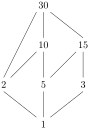
Indication.
19.5.4.
19.5.5.
19.5.6.
19.5.8.
19.5.10.
19.5.14.
Indication.
Soient \(I, J\) des idéaux de \(R\text{.}\) Nous devons montrer que \(I + J = \{ r + s : r \in I \text{ et } s \in J \}\) est le plus petit idéal de \(R\) contenant à la fois \(I\) et \(J\text{.}\) Si \(r_1, r_2 \in I\) et \(s_1, s_2 \in J\text{,}\) alors \((r_1 + s_1) + (r_2 + s_2) = (r_1 + r_2) +(s_1 + s_2)\) est dans \(I + J\text{.}\) Pour \(a \in R\text{,}\) \(a(r_1 + s_1) = ar_1 + as_1 \in I + J\) ; donc \(I + J\) est un idéal de \(R\text{.}\)
19.5.18.
19.5.20.
Indication.
\(( \Rightarrow)\text{.}\) \(a = b \Rightarrow (a \wedge b') \vee (a' \wedge b) = (a \wedge a') \vee (a' \wedge a) = O \vee O = O\text{.}\) \(( \Leftarrow)\text{.}\) \(( a \wedge b') \vee (a' \wedge b) = O \Rightarrow a \vee b = (a \vee a) \vee b = a \vee (a \vee b) = a \vee [I \wedge (a \vee b)] = a \vee [(a \vee a') \wedge (a \vee b)] = [a \vee (a \wedge b')] \vee [a \vee (a' \wedge b)] = a \vee [(a \wedge b') \vee (a' \wedge b)] = a \vee 0 = a\text{.}\) Un argument symétrique montre que \(a \vee b = b\text{.}\)
20 Espaces vectoriels
20.5 Exercices
20.5.3.
20.5.5.
20.5.7.
20.5.10.
20.5.12.
20.5.15. Transformations linéaires.
Indication.
(a) Soient \(u, v \in \ker(T)\) et \(\alpha \in F\text{.}\) Alors
\begin{gather*}
T(u +v) = T(u) + T(v) = 0\\
T(\alpha v) = \alpha T(v) = \alpha 0 = 0\text{.}
\end{gather*}
Donc \(u + v, \alpha v \in \ker(T)\text{,}\) et \(\ker(T)\) est un sous-espace de \(V\text{.}\)
(c) L’affirmation que \(T(u) = T(v)\) est équivalente à \(T(u-v) = T(u) - T(v) = 0\text{,}\) ce qui est vrai si et seulement si \(u-v = 0\) ou \(u = v\text{.}\)
20.5.17. Sommes directes.
21 Corps
21.5 Exercices
21.5.1.
21.5.2.
21.5.3.
21.5.5.
Indication.
21.5.8.
21.5.14.
Indication.
Supposons que \(E\) est algébrique sur \(F\) et \(K\) est algébrique sur \(E\text{.}\) Soit \(\alpha \in K\text{.}\) Il suffit de montrer que \(\alpha\) est algébrique sur une extension finie de \(F\text{.}\) Puisque \(\alpha\) est algébrique sur \(E\text{,}\) il doit être le zéro d’un polynôme \(p(x) = \beta_0 + \beta_1 x + \cdots + \beta_n x^n\) dans \(E[x]\text{.}\) Donc \(\alpha\) est algébrique sur \(F(\beta_0, \ldots, \beta_n)\text{.}\)
21.5.22.
Indication.
Puisque \(\{ 1, \sqrt{3}, \sqrt{7}, \sqrt{21}\, \}\) est une base de \({\mathbb Q}( \sqrt{3}, \sqrt{7}\, )\) sur \({\mathbb Q}\text{,}\) \({\mathbb Q}( \sqrt{3}, \sqrt{7}\, ) \supset {\mathbb Q}( \sqrt{3} +\sqrt{7}\, )\text{.}\) Puisque \([{\mathbb Q}( \sqrt{3}, \sqrt{7}\, ) : {\mathbb Q}] = 4\text{,}\) \([{\mathbb Q}( \sqrt{3} + \sqrt{7}\, ) : {\mathbb Q}] = 2\) ou 4. Puisque le degré du polynôme minimal de \(\sqrt{3} +\sqrt{7}\) est 4, \({\mathbb Q}( \sqrt{3}, \sqrt{7}\, ) = {\mathbb Q}( \sqrt{3} +\sqrt{7}\, )\text{.}\)
21.5.27.
Indication.
Soit \(\beta \in F(\alpha)\) non dans \(F\text{.}\) Alors \(\beta = p(\alpha)/q(\alpha)\text{,}\) où \(p\) et \(q\) sont des polynômes en \(\alpha\) avec \(q(\alpha) \neq 0\) et des coefficients dans \(F\text{.}\) Si \(\beta\) est algébrique sur \(F\text{,}\) alors il existe un polynôme \(f(x) \in F[x]\) tel que \(f(\beta) = 0\text{.}\) Soit \(f(x) = a_0 + a_1 x + \cdots + a_n x^n\text{.}\) Alors
\begin{equation*}
0 = f(\beta) = f\left( \frac{p(\alpha)}{q(\alpha)} \right) = a_0 + a_1 \left( \frac{p(\alpha)}{q(\alpha)} \right) + \cdots + a_n \left( \frac{p(\alpha)}{q(\alpha)} \right)^n\text{.}
\end{equation*}
Multipliez maintenant les deux membres par \(q(\alpha)^n\) pour montrer qu’il existe un polynôme dans \(F[x]\) qui a \(\alpha\) comme zéro.
21.5.28.
Indication.
Voir les commentaires suivant le Théorème 21.1.13.
22 Corps finis
22.4 Exercices
22.4.1.
22.4.4.
22.4.5.
22.4.7.
22.4.8.
22.4.11.
22.4.12.
22.4.17.
22.4.18.
Indication.
Puisque \(\alpha\) est algébrique sur \(F\) de degré \(n\text{,}\) on peut écrire tout élément \(\beta \in F(\alpha)\) de façon unique comme \(\beta = a_0 + a_1 \alpha + \cdots + a_{n - 1} \alpha^{n - 1}\) avec \(a_i \in F\text{.}\) Il y a \(q^n\) \(n\)-uplets possibles \((a_0, a_1, \ldots,
a_{n - 1})\text{.}\)
22.4.24. Théorème de Wilson.
23 Théorie de Galois
23.5 Exercices
23.5.1.
23.5.2.
23.5.3.
Indication.
Si
\begin{equation*}
[\gf(729): \gf(9)] = [\gf(729): \gf(3)] /[\gf(9): \gf(3)] = 6/2 = 3\text{,}
\end{equation*}
alors \(G(\gf(729)/ \gf(9)) \cong {\mathbb Z}_3\text{.}\) Un générateur de \(G(\gf(729)/ \gf(9))\) est \(\sigma\text{,}\) où \(\sigma_{3^6}( \alpha) = \alpha^{3^6} = \alpha^{729}\) pour \(\alpha \in \gf(729)\text{.}\)
23.5.4.
Indication.
23.5.5.
23.5.7.
Indication.
Soit \(E\) le corps de décomposition d’un polynôme cubique dans \(F[x]\text{.}\) Montrez que \([E:F]\) est inférieur ou égal à \(6\) et est divisible par \(3\text{.}\) Puisque \(G(E/F)\) est un sous-groupe de \(S_3\) dont l’ordre est divisible par \(3\text{,}\) concluez que ce groupe doit être isomorphe à \({\mathbb Z}_3\) ou à \(S_3\text{.}\)
23.5.9.
23.5.16.
23.5.20.
Indication.
-
Clairement \(\omega, \omega^2, \ldots, \omega^{p - 1}\) sont distincts puisque \(\omega \neq 1\) ou 0. Pour montrer que \(\omega^i\) est un zéro de \(\Phi_p\text{,}\) calculez \(\Phi_p( \omega^i)\text{.}\)
-
Les conjugués de \(\omega\) sont \(\omega, \omega^2, \ldots, \omega^{p - 1}\text{.}\) Définissez une application \(\phi_i: {\mathbb Q}(\omega) \rightarrow {\mathbb Q}(\omega^i)\) par\begin{equation*} \phi_i(a_0 + a_1 \omega + \cdots + a_{p - 2} \omega^{p - 2}) = a_0 + a_1 \omega^i + \cdots + c_{p - 2} (\omega^i)^{p - 2}\text{,} \end{equation*}où \(a_i \in {\mathbb Q}\text{.}\) Montrez que \(\phi_i\) est un isomorphisme de corps. Montrez que \(\phi_2\) engendre \(G({\mathbb Q}(\omega)/{\mathbb Q})\text{.}\)
-
Montrez que \(\{ \omega, \omega^2, \ldots, \omega^{p - 1} \}\) est une base de \({\mathbb Q}( \omega )\) sur \({\mathbb Q}\text{,}\) et examinez quelles combinaisons linéaires de \(\omega, \omega^2, \ldots, \omega^{p - 1}\) sont laissées fixes par tous les éléments de \(G( {\mathbb Q}( \omega ) / {\mathbb Q})\text{.}\)

