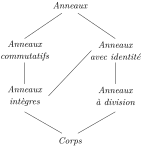
Pour un exemple d’anneau à division non commutatif, posons
\begin{equation*}
1 =
\begin{pmatrix}
1 & 0 \\
0 & 1
\end{pmatrix},
\quad
{\mathbf i}
=
\begin{pmatrix}
0 & 1 \\
-1 & 0
\end{pmatrix},
\quad
{\mathbf j} =
\begin{pmatrix}
0 & i \\
i & 0
\end{pmatrix},
\quad
{\mathbf k} =
\begin{pmatrix}
i & 0 \\
0 & -i
\end{pmatrix}\text{,}
\end{equation*}
où \(i^2 = -1\text{.}\) Ces éléments satisfont les relations suivantes :
\begin{align*}
{\mathbf i}^2 = {\mathbf j}^2 & = {\mathbf k}^2 = -1\\
{\mathbf i} {\mathbf j} & = {\mathbf k}\\
{\mathbf j} {\mathbf k} & = {\mathbf i}\\
{\mathbf k} {\mathbf i} & = {\mathbf j}\\
{\mathbf j} {\mathbf i} & = - {\mathbf k}\\
{\mathbf k} {\mathbf j} & = - {\mathbf i}\\
{\mathbf i} {\mathbf k} & = - {\mathbf j}\text{.}
\end{align*}
Soit \({\mathbb H}\) l’ensemble des éléments de la forme \(a + b {\mathbf i} + c {\mathbf j} +d {\mathbf k}\text{,}\) où \(a, b , c, d\) sont des nombres réels. De manière équivalente, \({\mathbb H}\) peut être considéré comme l’ensemble de toutes les matrices \(2 \times 2\) de la forme
\begin{equation*}
\begin{pmatrix}
\alpha & \beta \\
-\overline{\beta} & \overline{\alpha }
\end{pmatrix}\text{,}
\end{equation*}
où \(\alpha = a + di\) et \(\beta = b + ci\) sont des nombres complexes. On peut définir l’addition et la multiplication sur \({\mathbb H}\) soit par les opérations matricielles usuelles, soit en termes des générateurs \(1\text{,}\) \({\mathbf i}\text{,}\) \({\mathbf j}\) et \({\mathbf k}\) :
\begin{gather*}
(a_1 + b_1 {\mathbf i} + c_1 {\mathbf j} +d_1 {\mathbf k} ) + ( a_2 + b_2 {\mathbf i} + c_2 {\mathbf j} +d_2 {\mathbf k} )\\
= (a_1 + a_2) + ( b_1 + b_2) {\mathbf i} + ( c_1 + c_2) \mathbf j + (d_1 + d_2) \mathbf k
\end{gather*}
et
\begin{equation*}
(a_1 + b_1 {\mathbf i} + c_1 {\mathbf j} +d_1 {\mathbf k} ) ( a_2 + b_2 {\mathbf i} + c_2 {\mathbf j} +d_2 {\mathbf k} ) = \alpha + \beta {\mathbf i} + \gamma {\mathbf j} + \delta {\mathbf k}\text{,}
\end{equation*}
où
\begin{align*}
\alpha & = a_1 a_2 - b_1 b_2 - c_1 c_2 -d_1 d_2\\
\beta & = a_1 b_2 + a_2 b_1 + c_1 d_2 - d_1 c_2\\
\gamma & = a_1 c_2 - b_1 d_2 + c_1 a_2 + d_1 b_2\\
\delta & = a_1 d_2 + b_1 c_2 - c_1 b_2 + d_1 a_2\text{.}
\end{align*}
Bien que la multiplication semble compliquée, il s’agit en réalité d’un calcul direct si l’on se souvient que l’on additionne et multiplie les éléments de \({\mathbb H}\) comme des polynômes en tenant compte des relations entre les générateurs \({\mathbf i}\text{,}\) \({\mathbf j}\) et \({\mathbf k}\text{.}\) L’anneau \({\mathbb H}\) est appelé l’anneau des quaternions.
Pour montrer que les quaternions forment un anneau à division, il faut pouvoir trouver un inverse pour chaque élément non nul. Remarquons que
\begin{equation*}
( a + b {\mathbf i} + c {\mathbf j} + d {\mathbf k} )( a - b {\mathbf i} - c {\mathbf j} - d {\mathbf k} ) = a^2 + b^2 + c^2 + d^2\text{.}
\end{equation*}
Cet élément ne peut être nul que si \(a\text{,}\) \(b\text{,}\) \(c\) et \(d\) sont tous nuls. Donc si \(a + b {\mathbf i} + c {\mathbf j} +d {\mathbf k} \neq 0\text{,}\)
\begin{equation*}
(a + b {\mathbf i} + c {\mathbf j} + d {\mathbf k})\left( \frac{a - b {\mathbf i} - c {\mathbf j} - d {\mathbf k} }{a^2 + b^2 + c^2 + d^2} \right) = 1\text{.}
\end{equation*}